Repairs & Surface Preparation
Good resurfacing starts underneath the finish.
Are these cracks too serious to resurface over?
This is the part of the job nobody photographs. It's also the part that decides whether a resurfaced driveway still looks right in five years, or starts lifting in patches after the first hot summer.
To be clear about scope: this is surface repair and preparation carried out as part of resurfacing. It is not structural concrete repair or engineering assessment. If your slab needs that, the right answer is to tell you so.
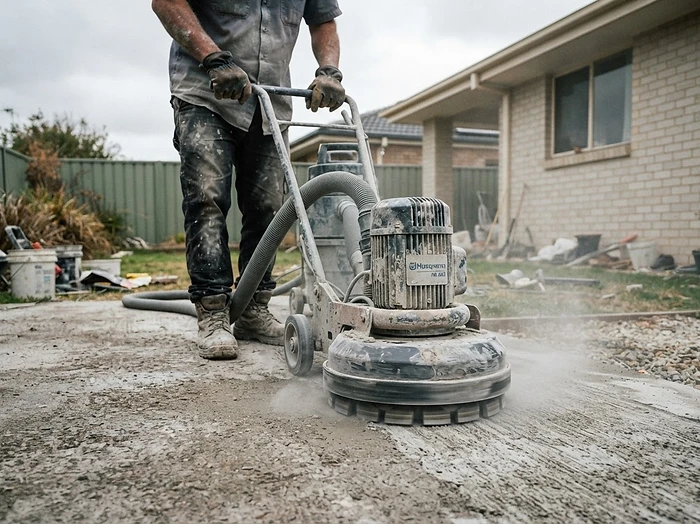
The invisible work
What preparation actually involves
Not every stage applies to every slab — but each one exists for a reason.
- 01
Assess
Look at the slab before touching it: is it level, is it stable, are cracks moving, is there moisture or drainage involved?
- 02
Clean
Pressure washing and degreasing to remove dirt, oil, salt residue and organic growth from the surface and its pores.
- 03
Remove
Old paint, failing coatings, adhesives and unsuitable surface material taken off mechanically rather than covered up.
- 04
Grind
Mechanical grinding opens up surfaces that are sealed, contaminated or too smooth for a new system to bond to.
- 05
Repair
Suitable cracks and surface defects cut out, filled and levelled where the assessment says that's appropriate.
- 06
Bond
Final preparation or priming so the resurfacing system goes onto a clean, sound, receptive surface.

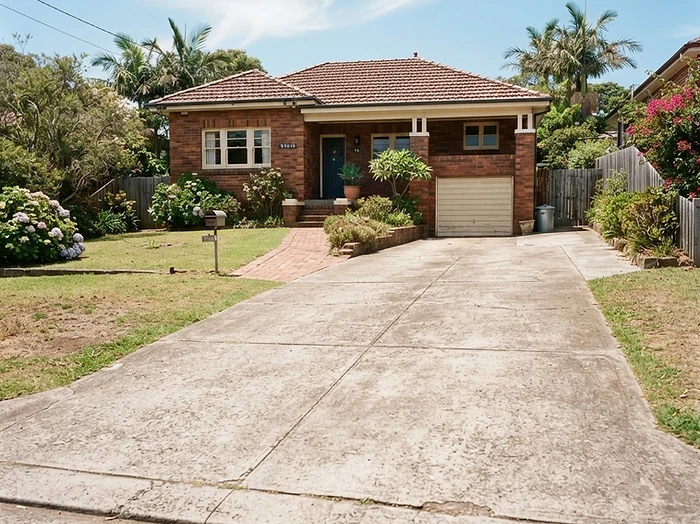
Cracks
Assessing cracks honestly
Cracks are the question we're asked about most, and the answer is genuinely "it depends" — but not vaguely so. What's being looked at is measurable: how wide the crack is, whether the edges sit level or one side has dropped, whether it runs through a control joint or across it, and whether there's evidence it's still moving.
Stable surface cracks can usually be treated and prepared. Active cracks reflect a slab that is still shifting, and a new surface can crack again along the same line. Nobody can honestly guarantee a crack will never reappear.
Read the full crack and preparation guidance in Before You Decide
Why it matters
Coating over poor preparation is the most expensive shortcut available.
A resurfacing system bonds to the top few millimetres of whatever it's applied to. If that layer is dust, oil, loose material or a coating that's already letting go, the finish inherits the problem.
The failure usually appears months later as lifting edges, hollow patches or peeling around the busiest areas. By then the only real fix is to remove the new surface and do the preparation properly.
When you compare quotes, compare the preparation. It's the single biggest difference between two prices for the same square metres.
Questions
Repair and preparation questions
Send a photo — we'll tell you what preparation it looks like it needs.
Send a few details and photos of your concrete. We'll tell you what looks restorable, what needs repair and when replacement genuinely makes more sense.
Call Now